


This is the first update from our John Ellerman Project Curator, Claire Dean, on the project De-tabooing Disposals in Regional Museums.
With head torch on, gloves for protection (of both objects and me), magnifiers, tape measure and hazard labels in my pinny pockets, I venture into the depths of the museum’s stores.
Mountainous roller racking stretches above me. I navigate between the racks and scour shelf after shelf of televisions, hoovers, pots and pans, tools and dolly tubs. Every day, I feel both nervous at how big the job is I’m here to do, and excited about what I might find hiding at the back of a high shelf.
Our stores, like those of most UK museums, are full. The Museums Association estimates that 10-15% of what’s in a museum store doesn’t belong there. For us to continue to collect important local objects we need to do some sorting out and make some space.
The project I’m working on is called De-tabooing Disposals. My first job is to reassure people that in a museum disposal doesn’t mean what you might think. Disposal in museum terms refers to removing objects that don’t belong in the museum from the collection and finding better homes for them.
So, how do we work out what doesn’t belong at Tullie? Well, it makes sense to start by working out what does belong. Our Collections Development Policy guides us in ensuring our collections cover the history, nature and art of Carlisle and north Cumbria. We want our collections to represent our communities and celebrate what makes Carlisle special and unique.
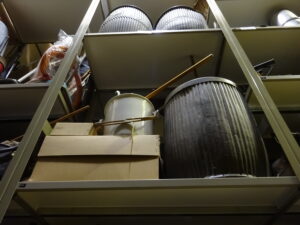
Dolly tubs, mops and possers (sticks used for stirring clothes in a wash tub) in the stores.
In the past, hundreds of mass-produced and duplicate objects without local links were collected. It’s my job to hunt these objects down. You can find more detailed information about why this is necessary in our project FAQs.
Exploring the stores in my headtorch is just the beginning of a lengthy process – next comes the detective work, where I gather all the information I can find on each object that’s being reviewed. An object’s importance is then considered by a panel of expert staff, and their recommendations are reviewed by our Senior Leadership Team and Cumberland Council.
If an object is approved for disposal, the search for new homes begins, whether that’s with our own Learning and Engagement teams, with other museums, or with schools, colleges or local community groups.
As a result, we’ll have more space on the shelves to better care for the objects that do belong at Tullie, and we’ll to be able to continue collecting Carlisle treasures of all kinds.
Meanwhile there are thousands of objects to be reviewed. If I haven’t returned from the stores by January 2025, please send a search party!
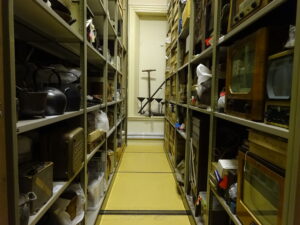
A glimpse into the stores.

