This page provides additional information on items from the Fine Art collection on display in the Reading Room (next to Café Tullie).
Art in the Reading Room
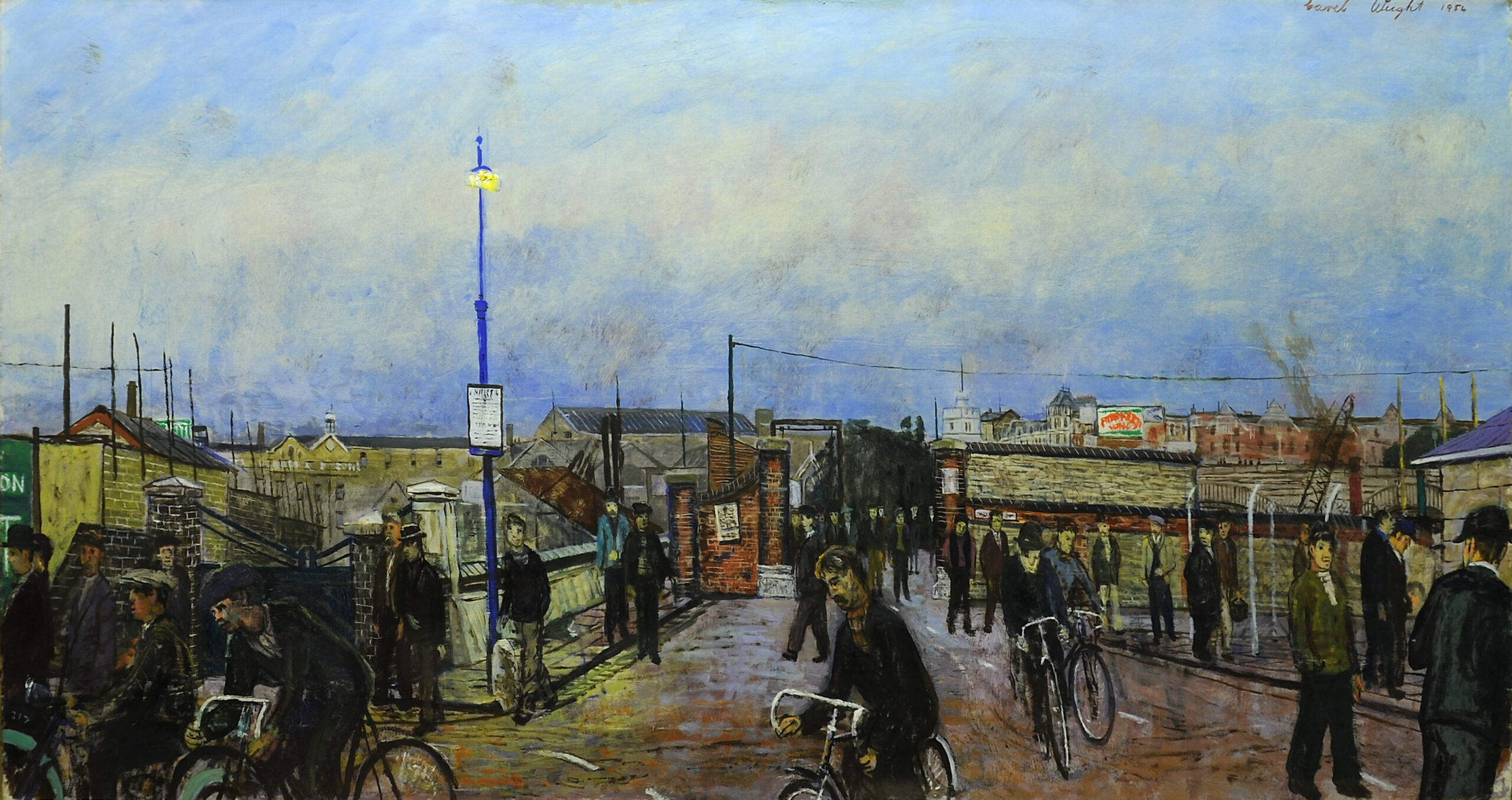
Men Leaving Work 1954
Carel Weight (1908–1997)
Oil on canvas
Purchased for Tullie House Museum and Art Gallery Trust Collection, 1955
Men emerge from the gates of a factory in Wandsworth, London, at the end of the working day. Some are on foot and others ride bikes. The rooftops of the suburbs rise above the factory’s tall brick walls.
Carel Weight lived near this scene and was inspired by his surroundings, his family, friends and own imagination for his works. He often set his paintings in twilight, the period of the day which most stimulated him. His works are often characterized by a sense of movement as we see here.
Carel Weight was third honorary Advisor to Tullie’s Purchase Scheme from 1952 to 1962. He took great pleasure in collecting works of art for Carlisle, purchasing 43 works in all. He purchased works by his fellow teachers and several of his own students for the Tullie collection. Weight’s broad artistic interests are also reflected in his acquisitions for the collection. Weight is also represented by four works in the Tullie collection. Weight accumulated during his lifetime, a large personal collection from which 91 works were bequeathed to Tullie in 1999. The bequest includes oil paintings, watercolours, drawings and prints dating from the 1700s to recent times by mostly British and French artists. The bequest is eclectic and reflects Weight’s interests as an artist but also complements his purchases as Advisor.
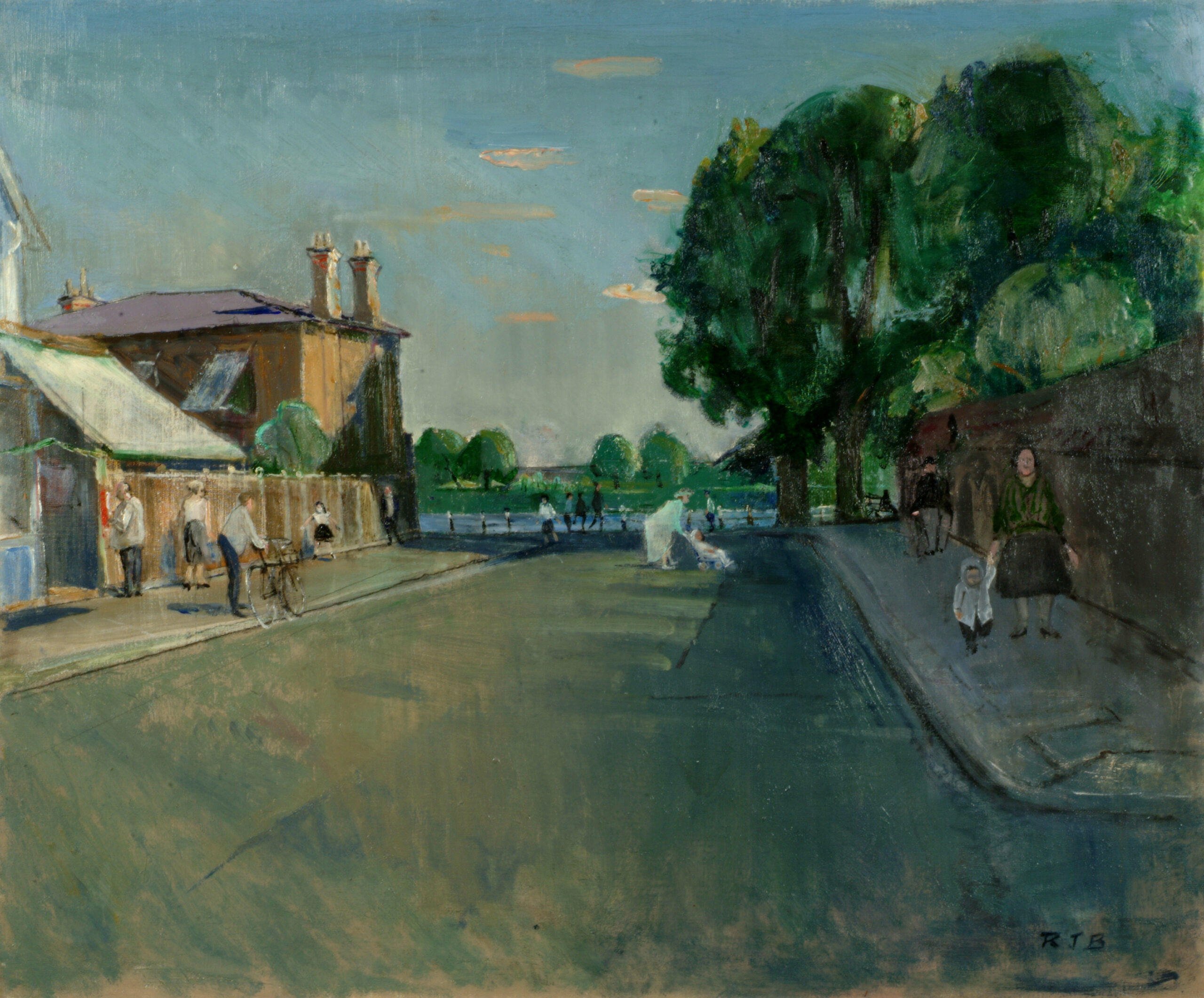
Thames Road, Chiswick, about 1963
Rodney Joseph Burn (1899-1984)
Oil on canvas
Purchased for Tullie House Museum and Art Gallery Trust Collection, 1963
This quiet street would have been familiar to the artist as his studio was on the banks of the Thames in Chiswick, London. The river Thames is visible at the end of the road in the distance.
Burn trained at the Slade where he won several prizes for his paintings. He painted figures and landscapes mostly in oil. He taught at several art schools including the Royal College of Art.
Roger de Grey, fourth Advisor to Tullie’s Purchase Scheme, purchased this painting for the Tullie collection from the Royal Academy Summer exhibition in 1963.
Abstract No.18, about 1966
Sandra Blow (1925-2006)
Oil and sand on canvas
Purchased for Tullie House Museum and Art Gallery Trust Collection, 1966
Sandra Blow was an abstract painter and one of the pioneers of British abstraction in the 1950s. Despite her dedication to abstraction her paintings were influenced by a sense of place. She often combined cheap materials such as sand, sawdust, sackcloth and plaster with paint giving her work a natural quality. These different materials enabled Blow to combine visual and tactile elements as we see here. Blow used sand in this large-scale painting which references her time in Cornwall.
Roger de Grey, fourth Advisor to Tullie’s Purchase Scheme, purchased this painting for the Tullie collection in 1966.

Still Life; Print of Roualt’s Clown, about 1967
William Gillies (1898-1973)
Oil on canvas
Purchased for Tullie House Museum and Art Gallery Trust Collection, 1967
The artist has carefully composed this still life introducing a white cloth underneath the black candlestick and terracotta dish to make them subtly stand out. The green vase and potted plant mirror each other at either side of the painting. Our eye is drawn to a black and white portrait of a clown by Georges Roualt on the wall behind. Roualt was a French artist who often depicted human suffering and tragedy.
Gillies was a Scottish painter who spent most of his career teaching at Edinburgh College of Art. He specialized in painting landscapes particularly in and around his home village of Temple, south of Edinburgh. He also painted still lifes and was influenced by Matisse.
Roger de Grey, Tullie’s fourth Advisor to the Purchase Scheme, purchased this painting for the Tullie collection from the Royal Academy Summer Exhibition in 1967.

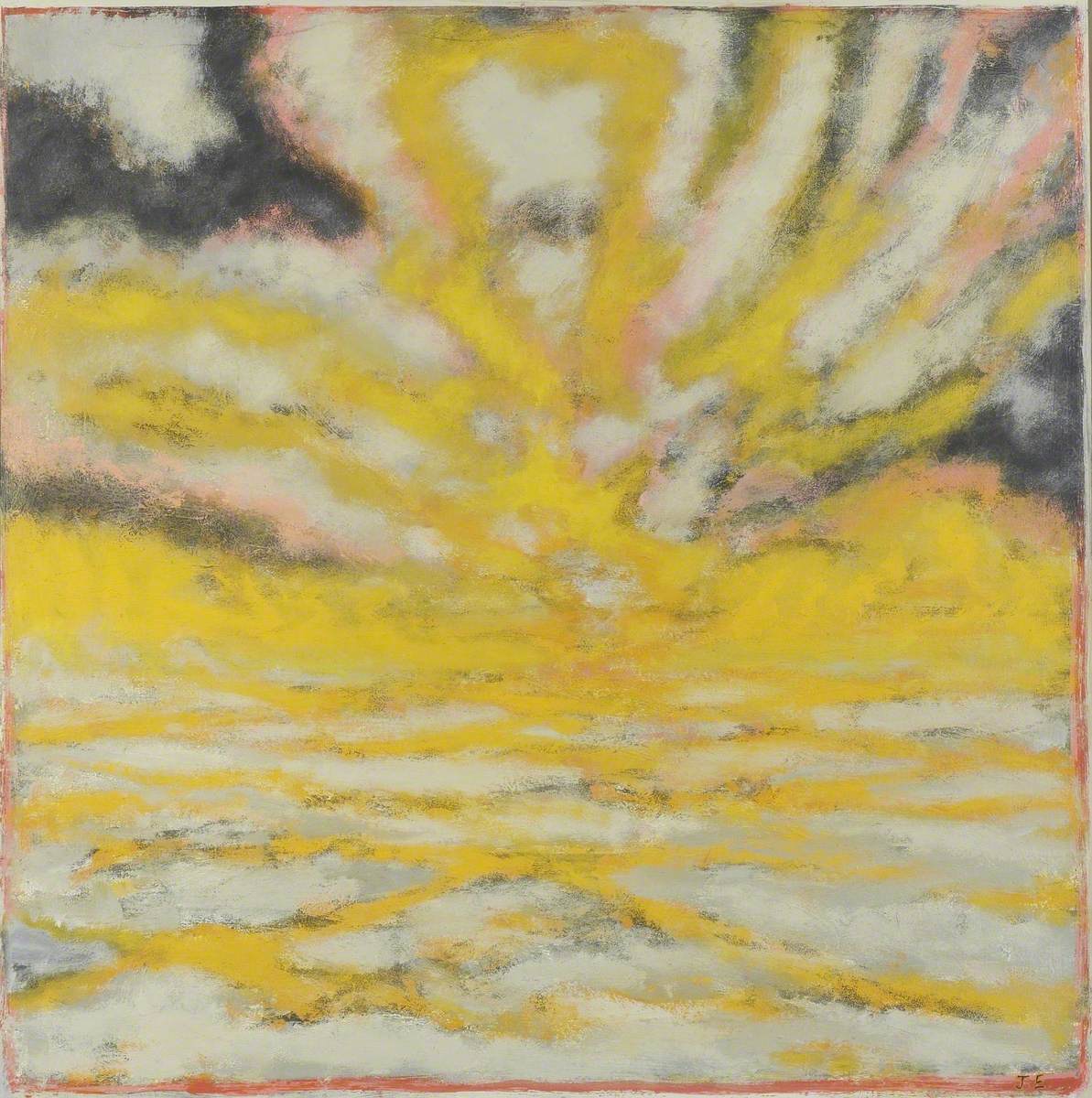
Yellow Tide, 1968
John Ellison (active 1958-1971)
Oil on board
Purchased for Tullie House Museum and Art Gallery Trust Collection, 1970
In this semi-abstract painting vibrant yellow and pink tinged clouds radiate from the sun and are reflected in the ripples of a calm sea below. Roger de Grey, Tullie’s fourth Advisor to the Purchase Scheme, purchased this work for the Tullie collection in 1970.
Self-Portrait (Slightly Sinister), 1973
Graham Greenfield (1951–)
Oil on canvas
Purchased for Tullie House Museum and Art Gallery Trust Collection, 1976
This self portrait of the artist as a young man shows him glancing towards an unseen person or object on his right. He has chosen to depict himself in the open air in front of a tall conifer. A tiny bi-plane can be seen in the cloudless sky above.
Roger de Grey, Tullie’s fourth Advisor to the Purchase Scheme, purchased this painting for the collection in 1976.

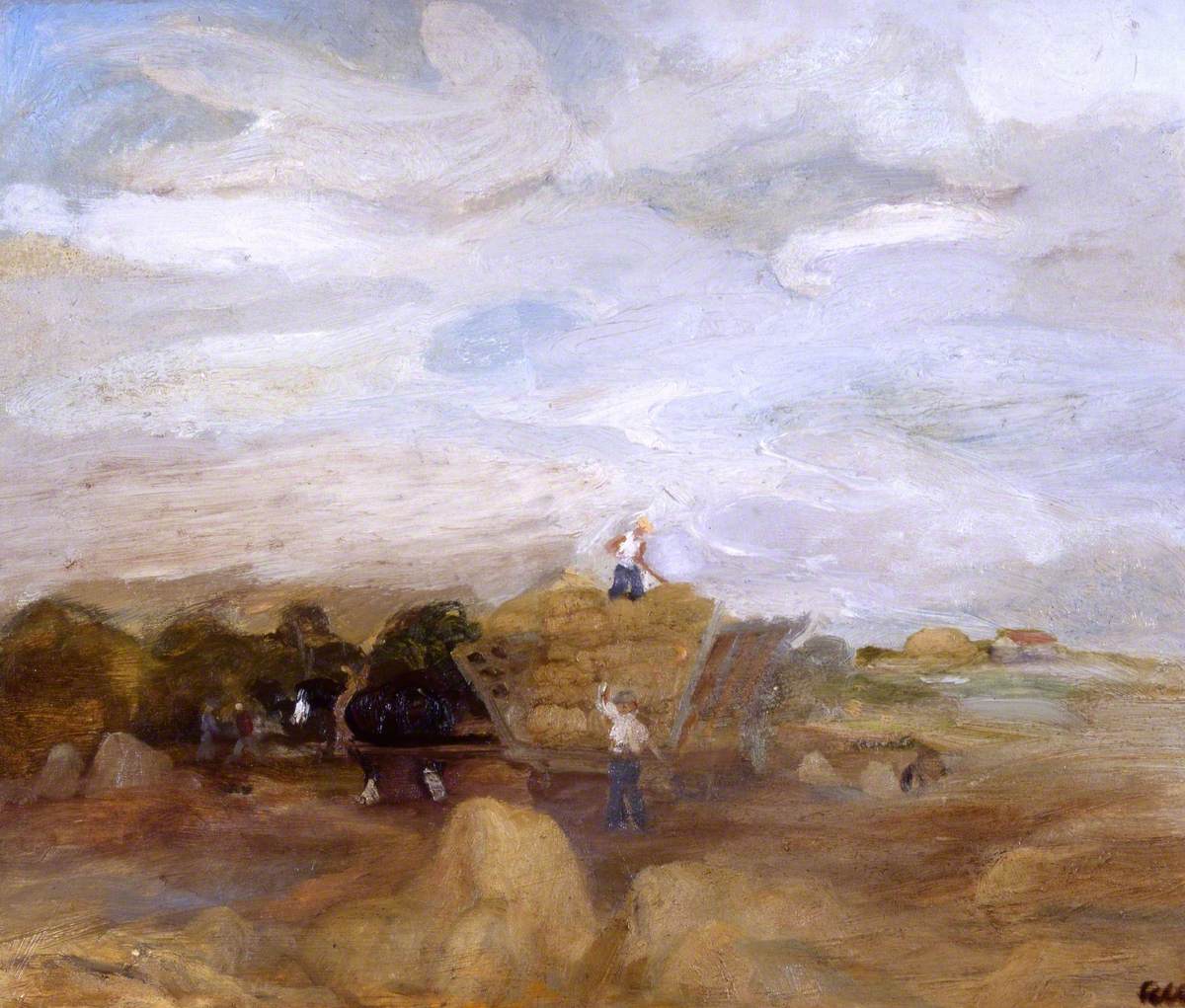
Harvest Field in Cumberland, 1975
Sheila Fell (1931–1979)
Oil on canvas
Purchased for Tullie House Museum and Art Gallery Trust Collection, 1976
Sheila Fell’s life-long obsession was painting Cumberland particularly the landscape she knew intimately around her home town of Aspatria, the Solway and northern fells. Farming on the Solway Plain was a subject she frequently painted. This bright and uplifting haymaking scene shows the landscape in summer on a cloudy day. In the centre of the composition a horse and cart stand beside a haystack being loaded onto a hay cart by two agricultural workers.
Despite spending most of her time in London, Fell made regular trips home to Aspatria to visit her parents and make drawings. She would then complete her paintings back in her studio in London.
Sheila Fell is one of Britain’s most significant artists from the mid-20th century and one of Cumbria’s leading women artists. She attended Carlisle College of Art 1947–9 and left Cumbria in 1949 to study at St Martin’s School of Art in London. Fell began exhibiting her landscape paintings at the Royal Academy in 1965 and was elected Associate in 1969 and Royal Academician in 1974.
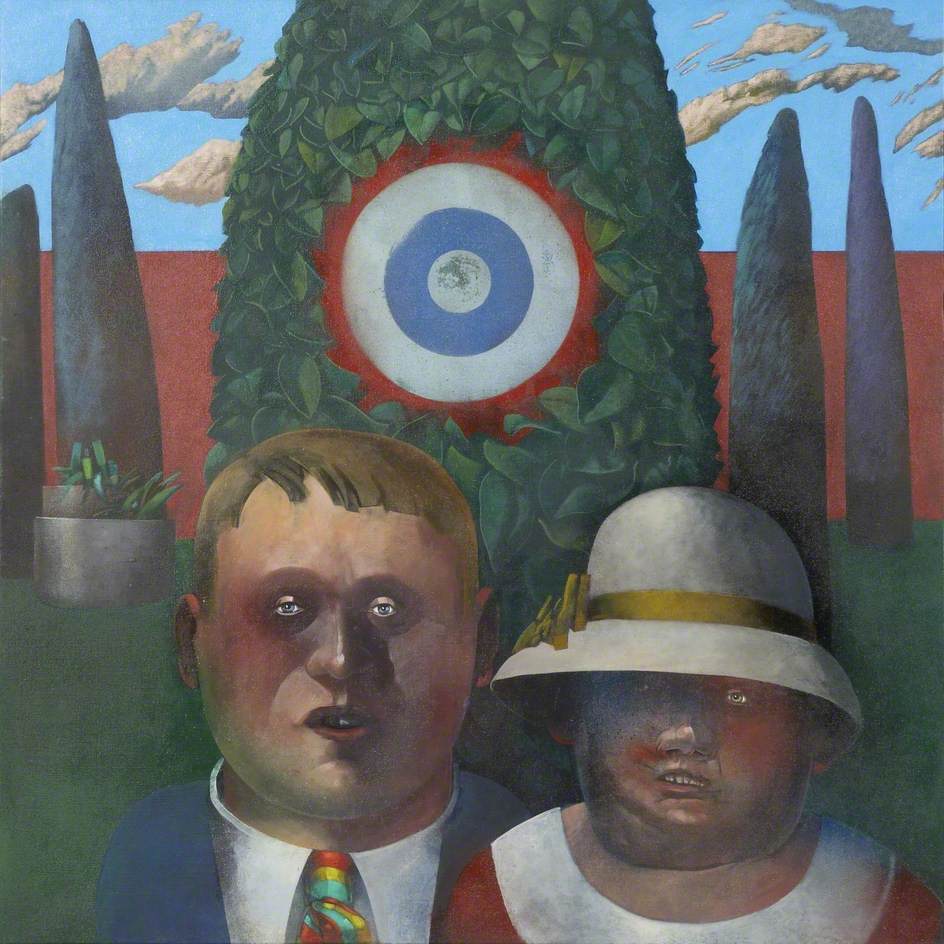
Boy and Girl in a Park, about 1965
Alan Dyer (1944-2025)
Oil on canvas
Purchased for Tullie House Museum and Art Gallery Trust Collection, 1979
A boy and girl dressed in smart clothes gaze directly towards the viewer. Behind them our eye is drawn to the target placed high in the tree. The park beyond has several tall trees bounded by a red wall. The artist has mirrored the colours of the target in the landscape.
Dyer trained in business before attending art school. He was also an art lecturer at Coventry University. His artistic output included a series of family portraits. Roger de Grey, Tullie’s fourth Advisor to the Purchase Scheme, purchased this painting for the Tullie collection in 1979.
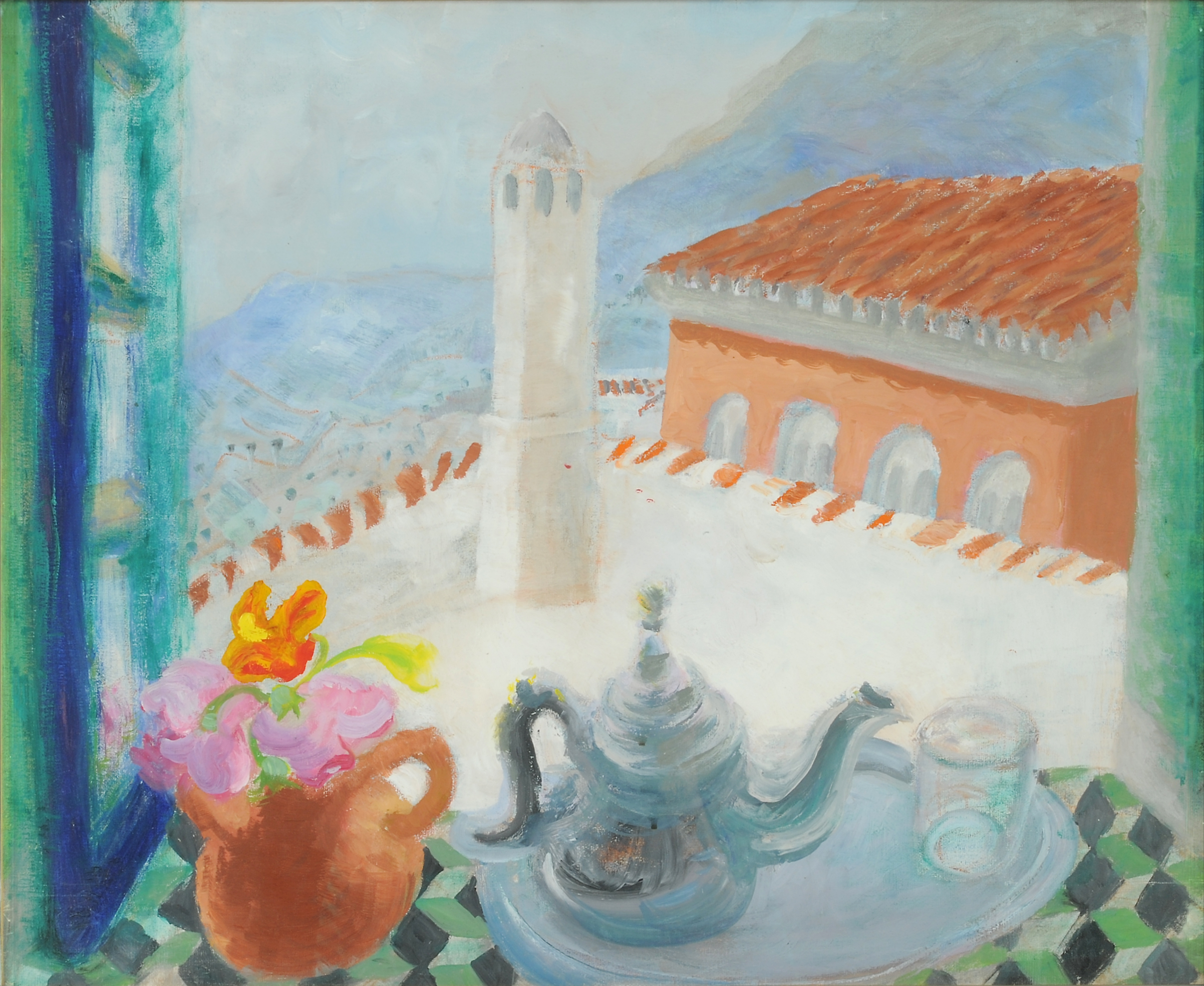
Chechovan, Morocco, about 1971
Winifred Nicholson (1893–1987)
Oil on canvas
Tullie House Museum and Art Gallery Trust Collection
Winifred Nicholson visited North Africa in the winter of 1969 and the spring of 1971 where she discovered new motifs and colour harmonies for her painting. Light and colour were central to her art and she has a national reputation for her colourful flower and landscape paintings.
Winifred Nicholson is one of Cumbria’s most important 20th century artists and a major British artist. She was the granddaughter of George Howard (1843–1911), 9th Earl of Carlisle, an artist and friend of the Pre-Raphaelites. She married the artist Ben Nicholson in 1920 and settled in an old Cumbrian farmhouse in 1924. She spent the majority of her life in Cumbria. Tullie has five works by Winifred Nicholson in the collection.
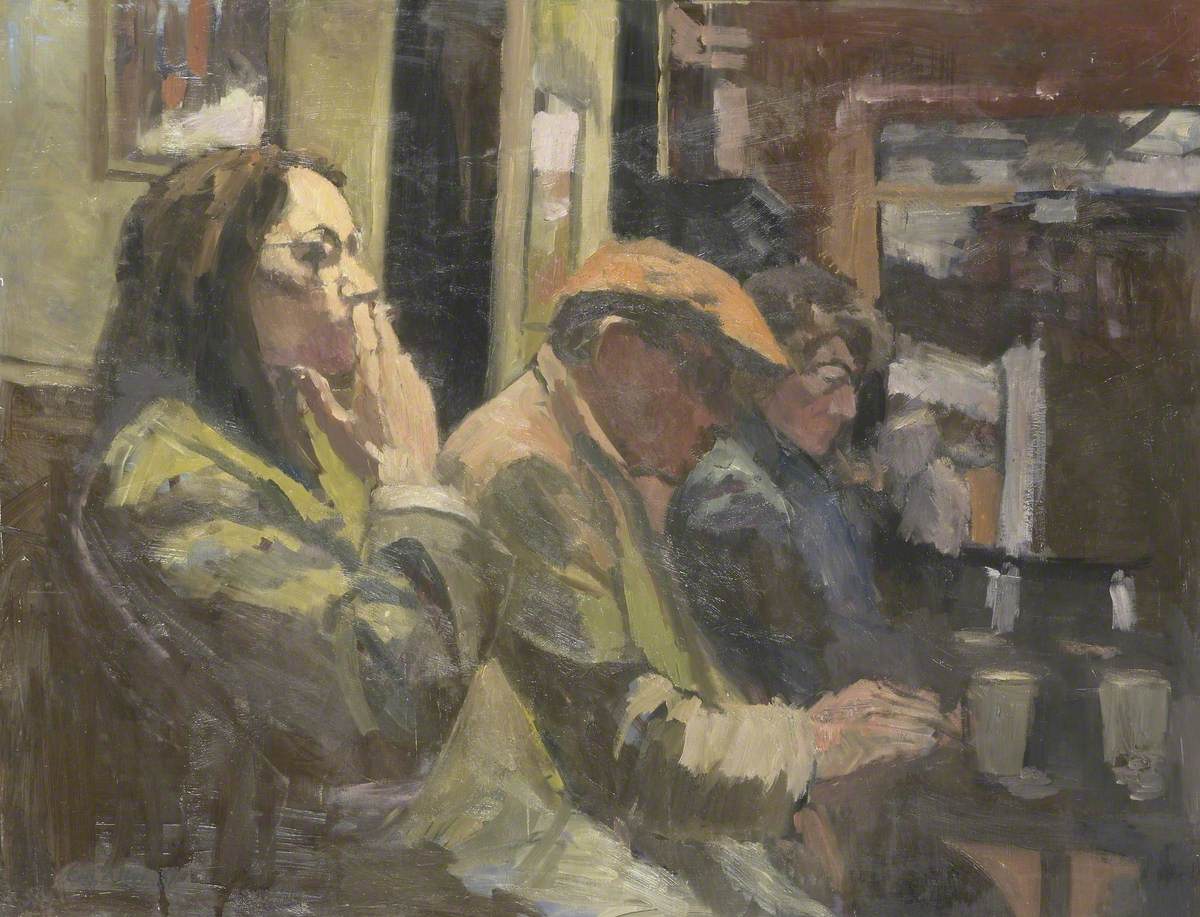
Waiting at Waterloo, 1987
Ceri Allen (1962-)
Oil on board
Purchased by the Friends of Tullie for the Tullie House Museum and Art Gallery Trust Collection, 1987
Three strangers are seated beside each other in a café at Waterloo station. All three are facing right viewed in profile. They all seem to be absorbed in their thoughts.
Ceri Allen is a figurative Cumbrian painter. She is the daughter of the artists Colin and Sadie Allen and studied painting at the City and Guilds School of Art, London. She has produced numerous commissions and exhibited widely. Her work is represented in public collections in the UK and USA.
Chris’s Garden, 1988
June Bennett (1935-2013)
Oil on canvas
Purchased for the Tullie House Museum and Art Gallery Trust Collection, 1988
A profusion of red poppies and blue irises fill a flower border in the back garden of Castlegate House Gallery in Cockermouth. The gallerist Chris Wadsworth set up the gallery in 1987 exhibiting work by modern and contemporary artists including Cumbrian artists.
June Bennett was born in Grange-over-Sands and studied art at Lancaster College of Art and Leicester College of Art. Her husband Mike Bennett was also an artist. She first practiced as a jeweller but later focused on painting bold colourful landscapes in situ and portraits. She had her first solo exhibition at Castlegate House in 1988. She exhibited widely and her work is held in several public collections.

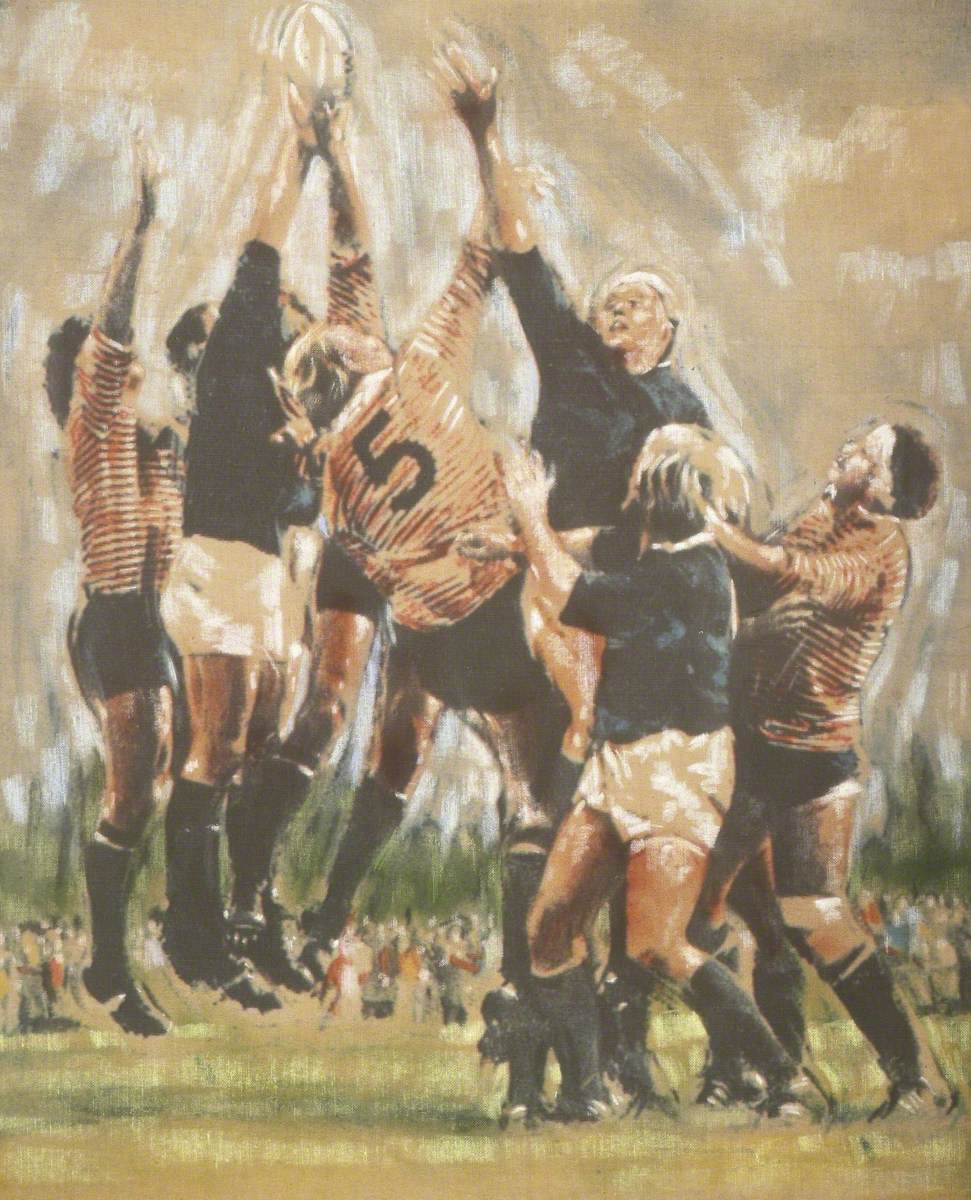
Line-Out of Rugby Union Teams – County Match between Cumbria and Lancashire, 17 October 1982
Harold Riley (1934-2023)
Oil on linen
Gift of John Branthwaite, 1997
Riley was born in Salford and trained at the Slade School of Fine Art. After training he returned to Salford where he focused on painting the surrounding area, its people and also painted portraits to commission. As a teenager Riley showed promise as a footballer but decided to focus his career on painting. He painted several leading footballers and was the perfect artist for this painting.
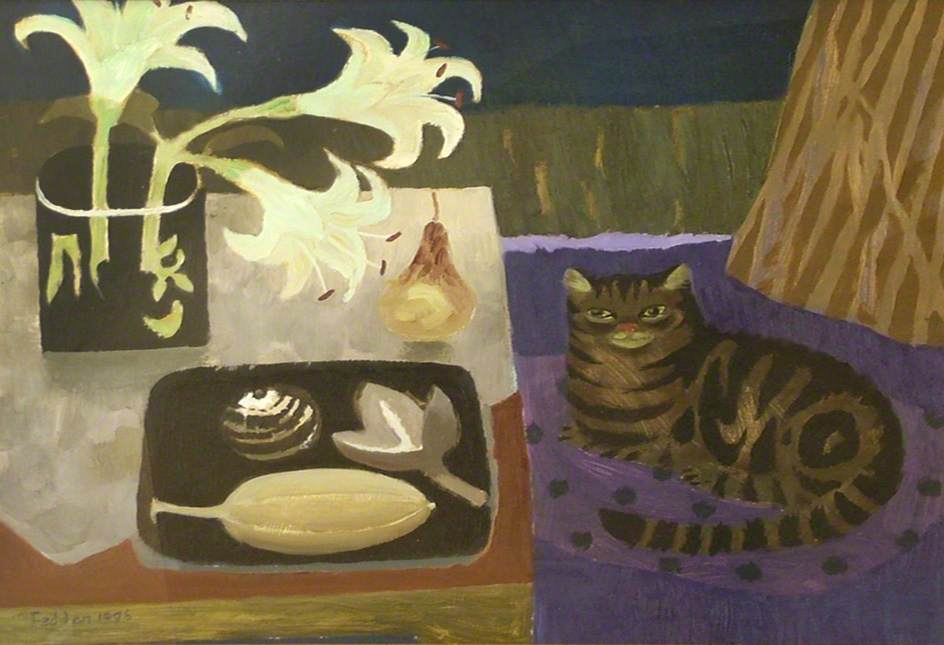
Tabby and Lilies, 1996
Mary Fedden (1915–2012)
Oil on board
Gift of Mary Fedden, 1997
Fedden is best known as a still-life painter. Her works are characterized by her love of decorative patterns, simple forms and flattened space. She painted at home, in her houseboat on the Thames, using her cat and favorite objects in her studio. She painted these objects in a strongly stylized way in vibrant colours. She studied at the Slade School of Fine Art and became the first woman tutor at the Royal College of Art 1958-1964. She was married to the artist Julian Trevelyan and was elected a Royal Academician in 1992.
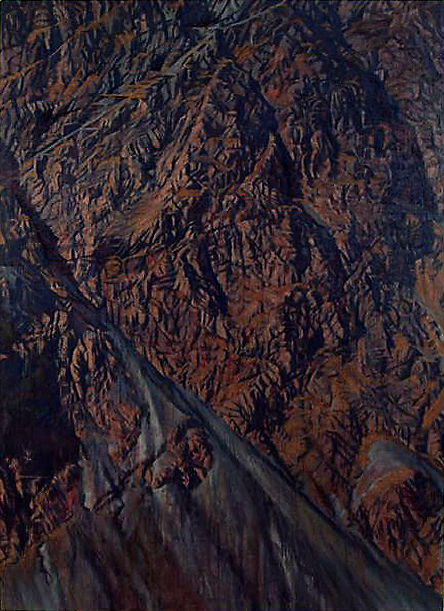
Large Honister Crag 2003-4
Julian Cooper (1947–)
Oil on canvas
Gift of Josephine Whitehead, 2004
Julian Cooper is one of Cumbria’s leading artists and is regarded as one of the most original and thought-provoking mountain painters working today. This painting is one of a series by the artist based on the old slate quarry at Honister Crag in the Lake District. Cooper has looked closely at mountains and rock formations for many years and in this painting attempts to convey the sense of awe we associate with seeing mountains. The painting itself is monumental in scale and was made in the artist’s studio from small studies made on the spot over a period of time, photographs and memory.
Julian Cooper was born in Grasmere; the son of William Heaton-Cooper and the grandson of Alfred Heaton-Cooper, both well-known Lake District landscape painters. His mother was the sculptor Ophelia Gordon Bell. Cooper studied at Lancaster School of Art and Goldsmith’s College of Art. He was awarded the Boise Travelling Scholarship and was resident at the British School at Rome. He has exhibited widely in the UK and abroad and his work is represented in numerous public collections.
Julian Cooper artist’s statement
This was the second of seven paintings I made during 2003–4 using the slate mine above Honister Pass at Buttermere in the Lake District as the starting point. What attracted me about the subject was the combination of the natural and the man-made, the one dissolving into the other, and the slightly eerie feel that the thousand foot-high crag has, due to the evidence of hard, dangerous working lives lived high on up the face that had been so intensively worked on over the last three-hundred years.
The slate mine above Honister is basically a vertical industrial site in the heart of the Lake District. The mountain has been hollowed out over time with a complex system of inclines on the surface and tunnels and caverns inside the crag. The man-made structures follow the line of the bedding planes of blue slate that lie at an angle of thirty degrees. There is a counterpoint between the sharp, structured rock buttresses and the flowing screes of slate debris which pour down from inside the hollowed-out mountain covering the outer surface. In each painting I dealt with a different section of the mountain, focusing on a particular conjunction of cave, rock, scree and grass, with sunlight and cloud-shadow as a fugitive extra element.
The industrial structures are slowly eroding back into the mountain and the place has the feel of an ancient Egyptian or Mayan site.
There are obvious parallels between the mountain subject and the surface of a painting. It’s important to me that I translate the rock forms into paint-structures and not merely imitate them. The familiar ‘all over’ template of the New York Abstract-Expressionist school of the 1950’s is brought to mind and enlivened when applied to an actual piece of terrain. These paintings are formed slowly by the continuous layering of the surface of the canvas with marks informed by my reading of the mountain’s surface. I try to internalize and understand every nuance of the subtle forms of the rock, one shape morphs into another in a way that is sometimes difficult to grasp mentally. Gravity acts as the unifying factor; both rock and paint tend to fall off to the bottom.
Meaning and emotion emerge into the painting sideways, as a result of this process of thinking with paint.
Lechuguilla (The Chandelier Ballroom) 2009
Monica Metsers (1980-)
Oil on board
Purchased for the Tullie House Museum and Art Gallery Trust Collection with assistance of the Friends of Tullie, 2013
Lechuguilla is a Spanish word meaning sea lettuce or neck ruff. Metsers’ starting point is to remodel broken children’s toys which she paints white and refashions into strange landscapes. She then photographs the results and works from these to create the painting. This process offers Metsers a return to childhood through acts of destruction.
Metsers is particularly interested in fantasy and the surreal. She was born in New Zealand but has lived in the Lake District for most of her life. She graduated with a master’s degree in fine art from Dundee University and has won awards for her work. She has exhibited widely and her work is represented in numerous private and public collections.

Through a Cottage Window, Shipley, Sussex, 1930s
Charles Ginner (1878–1952)
Oil on canvas
Purchased for the Tullie House Museum and Art Gallery Trust Collection, 1948
Ginner’s composition is dominated by a lush green landscape seen through a small cottage window. Van Gogh was a great inspiration to Ginner, influencing his use of thick paint and bright colours. Ginner painted with regular brushstrokes, creating firm outlines in his compositions.
Ginner was born in France and settled in London in 1910 bringing his knowledge of French painting with him. He was a founder member of the Camden Town Group and London Group and is well known for his urban paintings, particularly of London, and his landscapes. During the First World War Ginner served as a lieutenant for the Canadian War Records, and in the Second World War he served as an Official War Artist.

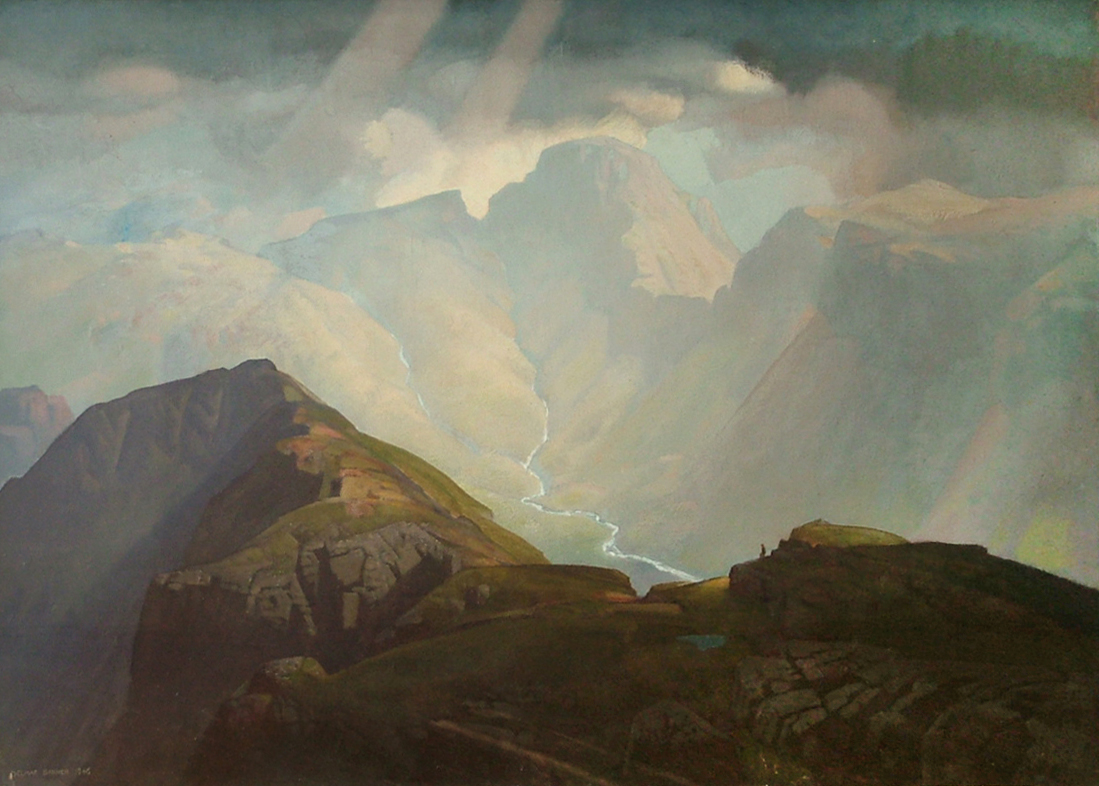
Great Gable from High Stile, 1946
Delmar Harmwood Banner (1896–1983)
Oil on canvas
Gift of Josephine de Vasconcellos, 1948
This panoramic view of Great Gable from High Stile in the Lake District is dramatically lit to heighten the intensity of the scene. Banner had a deep love of landscape which he recorded in detail on his walks. In his paintings he expresses his response to the landscape. Banner was born in Germany and studied at Cheltenham, Oxford and Regent Street Polytechnic. He married the sculptor, Josefina de Vasconcellos. During the latter part of their lives, they lived at Little Langdale near Ambleside in the Lake District.
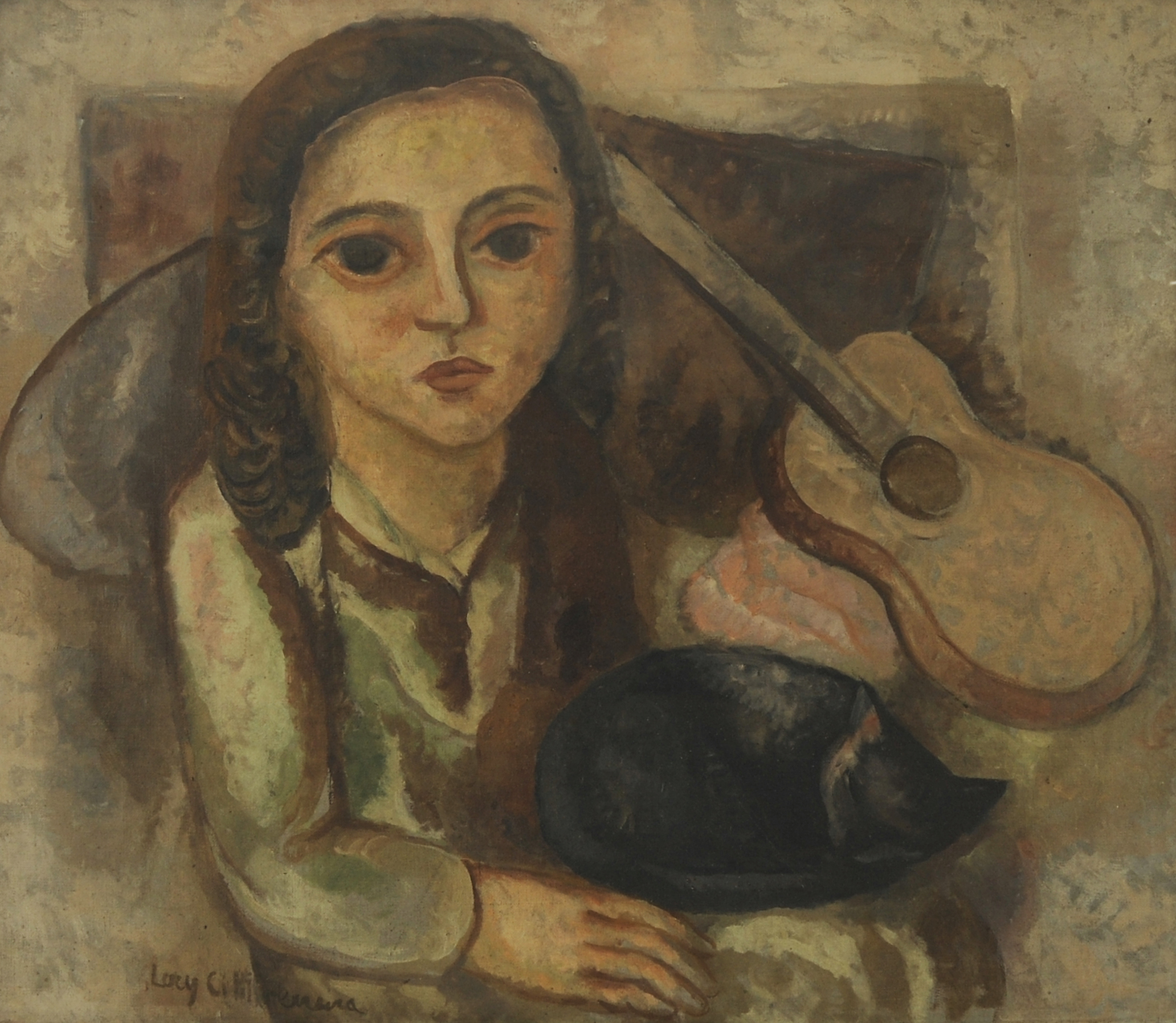
Menina e Gato (Girl with a Cat), 1943
Lucy Citti Ferreira (1914-2008)
Oil on canvas
Gift of the artist, 1949
This painting was included in the first group exhibition of Modern Brazilian paintings in Europe in 1944. Over 70 Brazilian contemporary artists donated 168 paintings to the exhibition in aid of the Royal Air Force Benevolent Fund to support Britian’s war effort. The exhibition was arranged by the British Council and Brazilian Ministry of Foreign Affairs. Over 100,000 people visited the exhibition at the Royal Academy and eight locations around the UK. After the exhibition, the British Council gifted the paintings to UK museums and galleries including this painting to Tullie.
Lucy Citti Ferreira was born in São Paulo, studied in Paris, and exhibited there in the 1930s. She returned to Brazil in 1935 and although she continued to paint for the rest of her life and exhibit her work, as a woman artist she was largely overlooked. In 2013, an exhibition of her work in her native city re-evaluated her contribution to Brazilian Modernism.