


One of the joys of my job on the De-tabooing Disposals project is coming across intriguing objects in the stores. The main focus of my role is to find objects that don’t belong at Tullie, but to do that I need to work my way through the shelves and research what I find there.
All museums have limits to their display space, so many objects remain in storage, sometimes for decades at a time. In Tullie’s Social History Collections, the real treasures tucked away in the stores aren’t made of precious metals or jewels – they’re the everyday objects that can help us share something vivid about people’s lives in Carlisle’s past.
Sometimes, I find what I’ve come to think of as rabbit-hole treasures in the stores. Encountering these objects takes me off down fascinating research rabbit holes (which I have to remember to emerge from as I have a lot of paperwork to get done!). For example, when I first lifted down a light and an unusual-shaped object, wrapped up in tissue, I had no idea what it could be. It was nowhere near the railway collections to which I found the object has a direct connection.
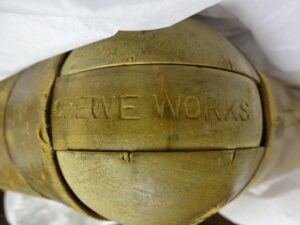
Elbow joint of a prosthetic arm engraved ‘Crewe Works’.
Joseph William Elliott was a railway worker who lost an arm in a rail accident in Corkickle on 4th April 1909. The wood and leather prosthetic I unwrapped had been used by him. The words carved into the elbow joint indicate it was made at ‘Crewe Works’. Alarmingly, railway accidents were so common that LNWR designed and made their own supply of prosthetics for employees at Crewe, alongside building trains. Documents show that Joseph forfeited compensation to return to work as a storesman in the Carlisle Steam Sheds and received an ‘artificial arm free of charge’ from the company in return.
This is the kind of object that definitely belongs in Tullie’s collections as it helps tell a story about the common dangers of railway work, and the challenges the absence of free healthcare brought for people in Carlisle in the early 20th century.
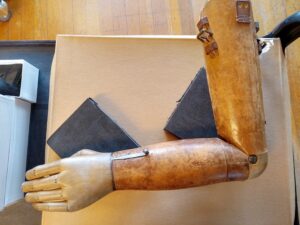
Joseph William Elliott’s prosthetic arm.
Another everyday object with an interesting story, is the almost entirely black bicycle I came across in our off-site store. Hidden amongst boneshakers and modern bikes, it was unremarkable apart from a single white stripe on its rear mud guard. I later discovered this means it was used during blackouts in the second world war. Our records show it first belonged to an unnamed Carlisle woman who purchased it from Bells in Abbey Street c. 1940. It was later resold to a Mrs Legge who despite ‘attracting sarcastic comments from some of the young men she passed’ used it for local shopping trips up until she donated it to the museum in 1986.
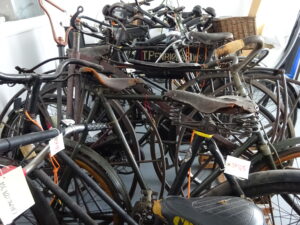
Some of the bicycles in the museum collection.
A recent find I’ve fallen in love with, is a doll’s house that was stored alongside fridges, ovens, and farm machinery in our off-site store. It has several broken windowpanes, two miniature reproduction paintings had fallen to its floors, and plates were the only things in the kitchen cupboards. Some research revealed it’s a 1930s dolls house and it belonged to Dorothea Gascoigne, daughter of George Edward Gascoigne, who worked as an artist at Metal Box in Carlisle.
The dolls house came in as part of a very large house clearance in the 1990s. This was such a big accessioning job that some of the objects, including this house, seem to have missed being fully documented. When something isn’t on our digital catalogue we can’t search for it, and so unless we happen to come across it in our stores, we don’t know it exists. I later found a cardboard box labelled ‘To be accessioned’ in another store, full of furniture and dolls that belonged to this house. These can now be documented, properly stored, and displayed in the house in future.
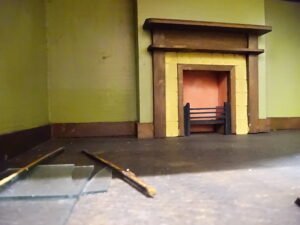
The living room in the doll’s house.
Museums operate on incredibly long timescales and Tullie has hundreds of thousands of objects in its care. Good collections management is essential, so we know what we have, and we can ensure objects remain connected to their stories. All objects should be marked with a unique accession number, but these can wear off, or labels become detached, and staff knowledge is lost over time.
Sometimes objects hide in plain sight, like the ladder reaching to the ceiling that I’d at first assumed belonged to the store – it’s actually from a railway signal box near the site of the 1915 rail disaster at Quintinshill – or the silver-painted garden chairs that turned out to be top deck tram seats. Made in the early 20th century, the seats have rounded slats so the Carlisle rain could run off them, and backrests that pivot for the change in direction at the end of the line.
All of these objects are time-travelling treasures that can help close the gap between people today and those who lived in Carlisle in the past. Now the current curators know about these objects, they can be featured in future displays. So, the disposals process not only shows us what doesn’t belong at Tullie, it helps us rediscover what really does belong here too.


Hi, what an interesting project. I do know you have a mummy covering in the collection and was wondering if that is one item up for rehoming.
Joann Fletcher the eminent Egyptologist has in the past shown interest in this item.
I would hate for this important item, which is Carlisle and District Egyptology Society’s cover photo to remain in the depths.
If you would like to talk to me, I am Chair of the Society I would love to chat to you
Hi Janet,
Thanks so much for your comment, I will pass your message and details on to the Project Curator.
Best wishes.